Sergio X. Madrigal, Ph.D.
A Pithy Primer of Chess
Your Move
Copyright 2021 Sergio X. Madrigal, Ph.D.
Get your paperback copy of Your Move: A Pithy Primer of Chess by clicking the Buy Now button on the left.
Paperback $9.95
Get your beautiful case laminate hardcover edition of Your Move: A Pithy Primer of Chess by clicking the Buy Now button on the left.
Hardcover $19.95
7
The Phases of the Game
A chess game is divided into three phases to be able to best discuss how to play a game. The three phases are: 1) the Opening, 2) the Middle Game, and 3) the Endgame. This seems obvious and simplistic but it turns out that this makes sense because each phase has different needs and there-
Phase One: The Opening
The need in the opening is to prepare your side for the coming chess battle. Since there is a lot of space between the White side and the Black side at the start of the game (that is, thirty-
So, there are only two famous games that are very short. They are short because one side makes very bad moves that help the other side. One game is finished in two moves and is called Fool’s Mate. The moves for Fool’s Mate were shown at the end of Chapter 6 – The Written Record. The second short game is over in three and a half moves and is called Scholar’s Mate (shown below). The moves thru White’s second move are an actually recognized opening called Bishop’s Opening. But in Scholar’s Mate, Black follows up with two very bad moves.
The moves for Scholar’s Mate are:
White Black
1. e4 e5
2. Bc4 Nc6?
3. Qh5 Nf6??
4. Qxf7#
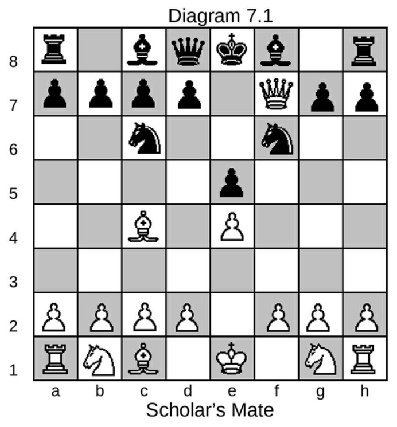
The final position is shown in Diagram 7.1. Interestingly, Black would have avoided mate if Black had made its third move as its second move, so this goes to show that timing matters. This mate also reveals the f-
So, the point is that one of the necessary things that you need to do in the opening is to bring out your chessmen without wasted moves to places where they will be ready for the coming battle, because the other side is trying to do the same thing! This is called “developing your chessmen”.
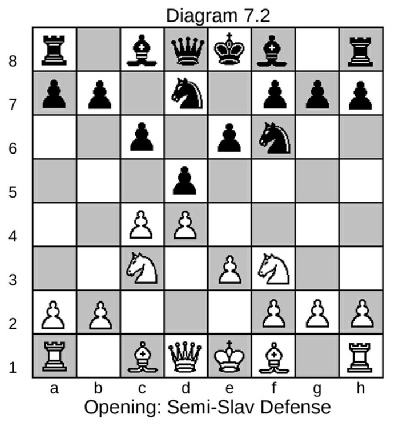
And if you can develop your pieces and pawns faster than your opponent, then you can probably attack sooner before the other side is fully prepared, and so you will have a better chance to get an advantage. But it’s also a fact that both sides are starting out with the same number of chessmen. So, before you can attack and checkmate the opponent’s King, you will have a better chance to do that if you have more chessmen or a more advantageous position than the opponent. So, part of the battle in the game is to attack other chessmen besides the King and try can get an advantage in material or position. The opening known as the Semi-
Phase Two: The Middle Game
The middle game is the portion of a chess game between the opening and the endgame; it is not possible to define the middle game in exactly defined terms (but typically from move 10 to move 30) because it describes the portion of the game after the goals of the opening are mostly achieved but before the game has progressed to the endgame, which is when at least one side (and usually both sides) have greatly reduced forces. In some games, the opposing forces have begun to be reduced in the opening and more exchanges quickly follow, leading to a very shortened middle game. In other games, the jockeying of the White and Black forces continues in the middle game for a while without many exchanges and the endgame is not reached for a significant number of moves. Nevertheless, the middle game is usually when the initial preparation to do battle on the chessboard is done and the further parrying and threatening and exchanging of chessmen continues in earnest.
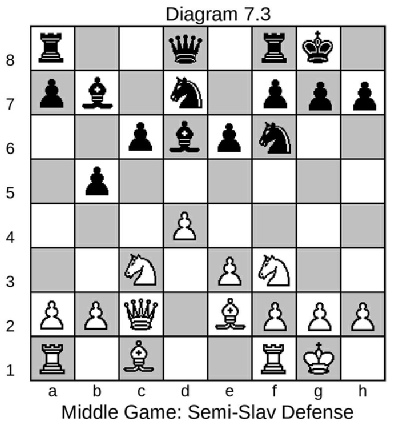
Diagram 7.3 shows the Semi-
One way to achieve a material advantage is to attack an opponent’s piece or pawn that is not protected by a fellow piece or pawn. Then you can just capture it. But your opponent is probably also trying to protect their chessmen (as you should also be trying to protect your chessmen), so it may be hard to find such a chessman. Sometimes, though, an opponent will overlook one of their unprotected chessmen, so be ever vigilant.

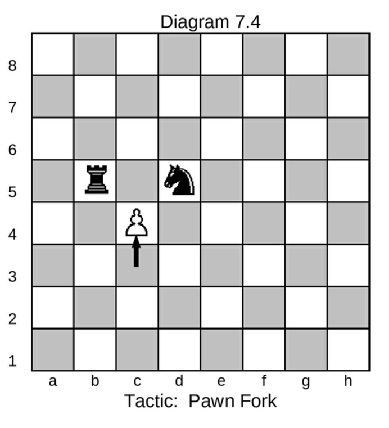
Another way to gain a material advantage is to attack two of the opponent’s unprotected chessmen with one move, a maneuver called a fork or double attack. Your opponent will usually only be able to move or protect one of the two attacked chessmen, which lets you capture the other chessman that you threatened. Such a tactic is shown in Diagram 7.4, which shows a Pawn fork. Detailed exposition of many other tactics will be discussed in Chapter 10 – The Middle Game, though it should be kept in mind that tactics can be used in any phase of the game.
Phase Three: The Endgame
The Endgame, like the Middle Game, does not have an exactly defined beginning. Basically, it is the final portion of a game and is characterized by the much smaller number of chessmen on the board. Thus, a game could end with a checkmate or resignation in the Middle Game, when there are still plenty of chessman on the board; that is, a game could terminate without having had an endgame phase.
But, when a game has progressed to the situation where there are many less chessmen on the board than the thirty-
A position that has progressed into the late Endgame phase is shown in Diagram 7.5. Black can mate in a single move, by moving the Black Queen to b2, where it could check and mate because the Black Queen would be protected by its Black pawn on c3. On the other hand, White is at a disadvantage, having only a Queen and a Knight, whereas Black has a Queen, Rook, and three pawns. But the game changer is that it is White to move and in a very advantageous position, from which White can achieve checkmate in three moves, thus:
White Black
1. Na6++ Ka8
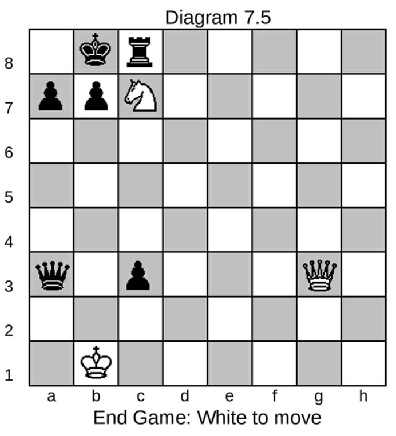
Starting from the position in Diagram 7.5, White’s move (1. Na6++) puts the Black King in double check, from both the White Knight and the White Queen. The only option that the Black King has is to move out of check (1. … Ka8), because Black cannot capture or block both pieces with only one move. Then the White Queen makes a surprising but incon-
2. Qb8+ Rxb8
3. Nc7# (see Diagram 7.6)
Now White wins the game with the Knight move (3. Nc7#) which is checkmate. This is called a smothered mate, since the Black King is smothered (immobilized) by its own fellow chessmen. It appears the King is caught between a Rook and a hard place.
Moves like these show how fascinating chess can be, where some elements like position and having the move can overcome a seeming disadvantage in material forces. The elements of chess will be discussed in more detail in Chapter 11 – The Elements of Chess.

Like the Opening, where a very large number of opening strategies have been developed over the centuries, there are similarly a very large number of strategies to analyze the Ending. But this large number of strategies becomes unmanageable for most players, so these are only studied extensively by the most dedicated grandmasters. Fortunately, a large number of these Endgame possibilities can be summarized into a few manageable number of simplified categories, which will be discussed in detail in Chapter 8 – The Endgame.
Rationale for sequence of exposition
It may seem puzzling to consider and analyze the three phases of a chess game in reverse order, as is done in the next few chapters of this book. The rationale for considering first the Endgame, followed by the Middle Game, and finishing with the Opening is that it is useful to know where one is headed before commencing the journey. For example, you would not want to reach an Endgame where you do not have the appropriate pieces to finish the game with a win.
That is, if you see that you do not have the appropriate chessmen to accomplish checkmate, your first recourse is to check to see if your opponent does have the appropriate chessmen to force checkmate. If your opponent also does not have the appropriate chessmen to force checkmate, the best recourse is to agree on a draw. If your opponent does have the appropriate chessmen to accomplish checkmate, your only alternative to resigning the game is to play on valiantly in hopes that your opponent makes an error sufficiently severe that it prevents a forced checkmate and leads to a draw or even equalizes the opposing forces where either side may win. In any case, it is best to know the minimum requirements necessary to force a checkmate. This knowledge will help you make the best decision at any point in the game.